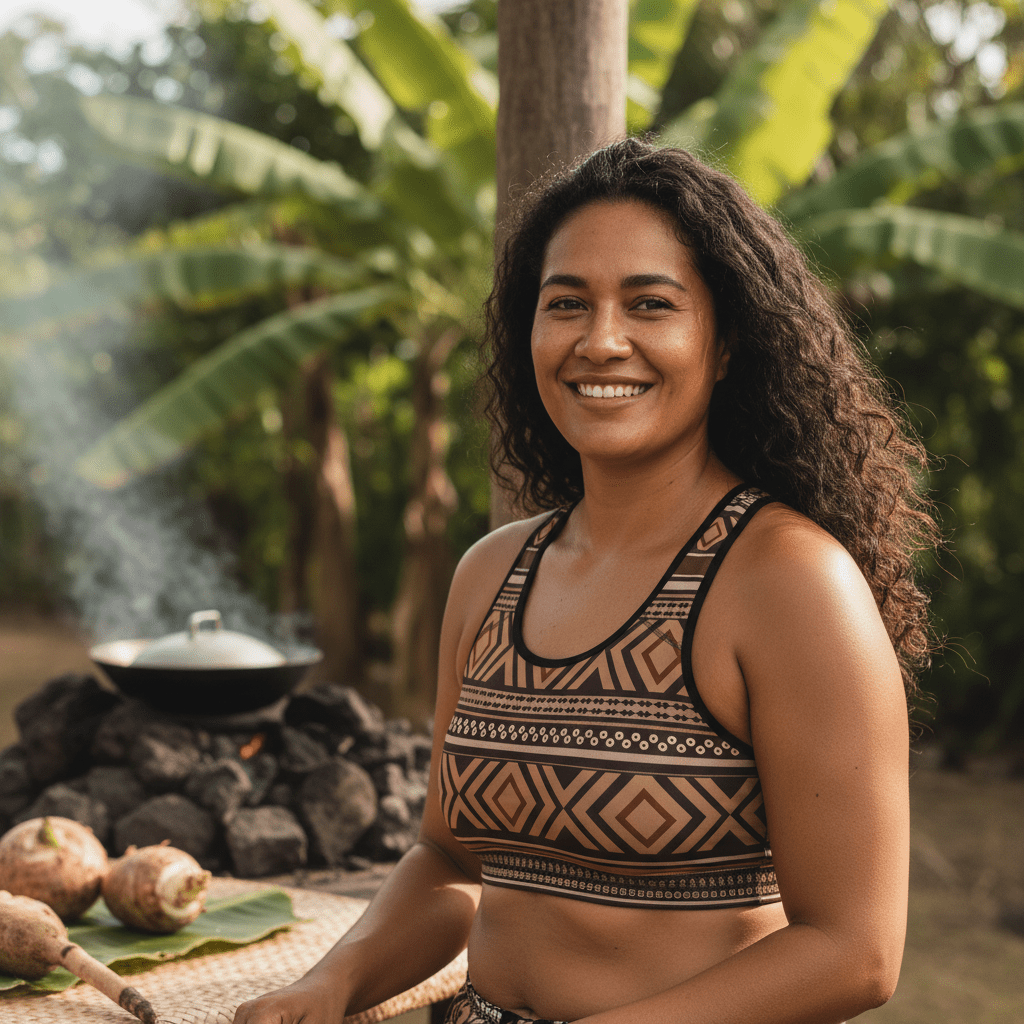
Traditional Samoan recipes are built on a handful of core ingredients: taro, coconut cream, cassava, banana, fish, and pork. These get combined using techniques developed over thousands of years of Pacific island cooking. This guide introduces the most important Samoan dishes, explains the cultural context behind each one, and links to full recipes for every dish covered. Whether you are cooking Samoan food for the first time or returning to the recipes you grew up with, start here.
In this guide
- The foundations of Samoan cooking
- The umu: the heart of Samoan cooking
- Essential Samoan savoury dishes
- Essential Samoan sweet dishes
- Essential Samoan baked goods
- Cooking Samoan food in the diaspora
- Get all the recipes in one place
- Frequently asked questions
What are the core ingredients in Samoan cooking?
Understanding a few key ingredients is the most important step in understanding Samoan food. Everything else follows from these.
| Ingredient | Samoan name | Key dishes |
|---|---|---|
| Coconut cream | Pe'epe'e / supo niu | Palusami, fa'ausi, oka, pani popo |
| Taro | Talo | Palusami, lu pulu, boiled as a side |
| Banana / plantain | Fa'i | Taufolo, fa'alifu fa'i, fa'ausi toppings |
| Cassava / tapioca | Manioka | Fa'ausi, pisua |
| Fish and seafood | I'a | Oka (raw fish) |
| Pork | Pua'a | Umu pork, sapasui, lu pulu |
Coconut cream is the one ingredient that appears in almost every Samoan dish, both savoury and sweet. If you understand coconut cream, you understand Samoan cooking. Always use full-fat, and fresh coconut cream whenever you have access to it.

All 24 traditional Samoan recipes in one hardcover. The most complete Samoan cookbook available. Worldwide shipping.
What is an umu and how does it work?
The umu (earth oven) is the foundation of Samoan feast cooking. Stones are heated in a fire until extremely hot. The fire is removed, food is placed on the hot stones and covered with leaves and more stones, then left to cook in the retained heat for 1 to 2 hours. The result is food with a distinctive smoky, earthy quality that cannot be fully replicated in a conventional oven.
Umu is used for every significant Samoan occasion: weddings, funerals, church events, family feasts, and community gatherings. In the diaspora, where umu cooking is often not practical, most dishes have been adapted for conventional ovens, slow cookers, and stovetops. The essential flavours survive these adaptations, though the smokiness of umu cooking is irreplaceable.
What are the essential Samoan savoury dishes?
Palusami
Young taro leaves filled with coconut cream and onion (often with corned beef), wrapped in more taro leaves, and cooked in the umu or oven. Palusami is the quintessential Samoan dish, present at every significant gathering. The coconut cream reduces and caramelises inside the leaf parcels, producing an intensely rich filling.
Full recipe: Palusami recipe, history and serving ideas
Oka (raw fish)
Fresh fish (typically tuna or snapper) marinated in fresh lemon or lime juice, then mixed with coconut cream, onion, tomato, and chilli. The citrus cures the fish through acid denaturation. Oka is light, bright, and intensely Pacific. It is made and eaten on the same day.
Full recipe: Oka recipe, history and serving ideas
Sapasui (glass noodle stir fry)
Glass noodles stir-fried with vegetables and typically pork or corned beef. Sapasui is a diaspora staple: the ingredients are universally available, it feeds many people from a single pot, and it reheats well. Despite its humble appearance, sapasui is one of the most requested dishes at Samoan gatherings.
Full recipe: Sapasui recipe, history and serving ideas
Umu pork
Whole or partial pork slow-cooked in the umu. The umu creates extraordinarily tender pork that falls off the bone. For diaspora cooking, slow cooker or oven-roasted pork shoulder is the closest adaptation.
What are the essential Samoan sweet dishes?
Fa'ausi
Grated cassava cooked in coconut cream and brown sugar until it forms a dense, rich pudding. One of the most beloved Samoan desserts, served at almost every significant gathering. The texture is unlike anything in Western baking: chewy, caramelised at the edges, and deeply coconutty.
Full recipe: Fa'ausi recipe, history and serving ideas
Koko alaisa
Samoan cocoa rice pudding made from koko Samoa (ground roasted cacao) cooked with rice and sugar. Rich, chocolatey, and completely Samoan in character. Eaten as breakfast in most Samoan households, it also makes an excellent dessert.
Full recipe: Koko alaisa recipe, history and serving ideas
Pani popo (coconut cream buns)
Sweet bread rolls baked in a coconut cream sauce. The sauce soaks into the base of the buns during baking, creating a rich, sweet, coconutty foundation. One of the most popular Samoan baked goods and a guaranteed crowd-pleaser at any gathering.
Full recipe: Pani popo recipe, history and serving ideas

All 24 recipes with precise measurements, tips, and variations. Download instantly and cook tonight.
What are the essential Samoan baked goods?
Panikeke
Samoan pancake doughnuts: small, round fried dough balls that are slightly sweet and pillowy. The quintessential Samoan street food and church fundraiser item. Easy to make at home with basic pantry ingredients.
Full recipe: Panikeke recipe, history and serving ideas
Pani popo (Samoan bread rolls)
Soft, slightly sweet bread rolls that became part of Samoan baking culture during the German colonial period and have stayed ever since. A staple of every Samoan gathering and one of the most approachable Samoan recipes for beginners.
How do you cook Samoan food in the diaspora?
The most common challenge for diaspora Samoans is the umu. Most diaspora homes cannot host an earth oven. But almost every traditional Samoan dish can be adapted:
- Umu-cooked dishes work well in a slow cooker (moist, tender results) or conventional oven (slightly drier but otherwise similar)
- Fresh coconut cream can be replaced with full-fat canned coconut cream. Always use full-fat, never light
- Taro is widely available in Pacific, Asian, and Caribbean grocery stores in New Zealand, Australia, and the United States
- Frozen grated cassava is available in Pacific and Asian grocery stores and works well in fa'ausi
- Cooking bananas and plantains are available in Pacific, Caribbean, and Asian grocery stores
The fa'a Samoa (Samoan way) in the diaspora is not about recreating Samoa exactly. It is about keeping the food alive with what you have. That is what these recipes are for.
Get all the recipes in one place
The individual recipes on this blog give you the method and the cultural context. For precise gram weights, ratios, timing, and troubleshooting for each dish, everything lives in the Samoan Delights cookbook series.

Six traditional Samoan mains including palusami and oka, with exact measures and the cultural story behind each dish.
Frequently asked questions
What are the most important ingredients in Samoan cooking?
The most important ingredients in traditional Samoan cooking are coconut cream, taro, banana (especially cooking bananas), cassava, fish and seafood, and pork. Coconut cream appears in almost every Samoan dish, both savoury and sweet. Taro is the most culturally significant food plant in Samoa.
What is an umu and how does it work?
An umu is a traditional Samoan earth oven. Stones are heated in a fire until extremely hot, the fire is removed, food is placed on the stones and covered with leaves, then left to cook in the retained heat for 1 to 2 hours. The umu produces food with a distinctive smoky, earthy flavour. Most umu dishes can be adapted for a conventional oven or slow cooker in diaspora cooking.
What is the most famous Samoan dish?
Palusami, taro leaves filled with coconut cream and cooked in the umu or oven, is perhaps the most beloved and iconic Samoan dish. Oka (raw fish in coconut cream) is widely celebrated as Samoa's signature seafood dish. Fa'ausi (cassava coconut cream dessert) is arguably the most beloved Samoan sweet.
Where can I find the ingredients for Samoan cooking?
In New Zealand and Australia, Pacific, Asian, and Caribbean grocery stores carry taro, cooking bananas, coconut cream, and cassava. In the United States, Pacific and Caribbean markets in areas with Samoan communities carry most Samoan cooking ingredients. Full-fat coconut cream is available in most supermarkets.
Are Samoan recipes difficult to make?
Most Samoan recipes are not technically difficult. They rely on good ingredients, proper technique for coconut cream dishes, and patience. The most complex element is umu cooking, which requires preparation and space. All traditional umu dishes can be adapted for home ovens or slow cookers with very good results.
What is the best Samoan recipe for beginners?
Panikeke (Samoan fried dough balls) and koko alaisa (cocoa rice pudding) are the most accessible starting points. Both require only a few pantry ingredients, take under 30 minutes, and introduce you to the flavour profile of Samoan food without needing specialist equipment. See the full panikeke recipe and koko alaisa recipe.
Every recipe, written down for keeps
The Samoan Delights cookbook series covers 24 traditional recipes with exact measures, cultural notes, and diaspora-friendly adaptations. Available as a keepsake hardcover or instant digital download.
Browse the cookbooks →Made-to-order by a Samoan-owned brand. Worldwide shipping.


