Quick answer: Traditional Samoan necklaces (ula) and tattoos (tatau) are among the most powerful expressions of cultural identity in Polynesia. The ula fala, made from pandanus seeds, signals Samoan identity at graduations and celebrations across the diaspora. The tatau pe'a (male) and malu (female) are sacred, earned marks of belonging and commitment. Today both inspire contemporary Samoan fashion and streetwear. When the designers are Samoan, that is cultural evolution, not appropriation. But the sacred tatau itself is always earned, never worn off a rack.
In this guide
- The ula: traditional Samoan necklaces
- The tatau: sacred tattoo tradition
- The tufuga ta tatau: guardians of the tradition
- From sacred tradition to streetwear
- Why wearing Samoan design matters today
- FAQ
Every piece of Samoan adornment carries a story. A traditional necklace is not jewellery in the Western sense. A tattoo is not decoration. These are visible statements of identity, status, lineage, and belonging within the social architecture of Fa'a Samoa.
As Samoan culture travels with the diaspora into cities across New Zealand, Australia, and the United States, these traditional symbols find new forms: in contemporary clothing, in streetwear inspired by ancient patterns, in the everyday choices of young Samoans who want to carry heritage with them. This guide explains the traditional meaning of Samoan necklaces and tattoos, and how those traditions shape modern Samoan visual culture, with one line held firm throughout: the sacred tatau is earned, and a printed design honours it without ever replacing it. At The Koko Samoa, that is the standard we work to.
The ula: traditional Samoan necklaces
The general Samoan word for necklace or garland is ula. Traditional Samoan necklaces serve a different purpose than decorative Western jewellery. They are ceremonial objects, gifts of honour, and markers of status and occasion.
| Necklace | Made from | Significance |
|---|---|---|
| Ula fala | Pandanus (fala) seeds, dried and strung | The most recognised Samoan necklace. Worn for celebrations, graduations, and welcoming ceremonies. A diaspora symbol of identity. |
| Ula nifo oti | Whale teeth (nifo oti) | One of the highest-value traditional items in Polynesia. Represents exceptional status, exchanged in ceremonies involving matai. |
| Ula lole | Lollies or sweets | Given to children at celebrations. Modern in form, but follows the tradition of ula as gifts of welcome. |
The ula fala has become an especially powerful diaspora symbol. Seeing one instantly communicates Samoan identity across cultural boundaries. At graduations, Pacific Island festivals, and community events in Auckland, Sydney, and Los Angeles, the ula fala is as recognisable a marker as the Samoan flag.

The garland of celebration, carried into everyday wear. Another Islander spots the ula fala across the room and you both know.
The tatau: sacred Samoan tattoo tradition
The Samoan tatau is one of the oldest continuous tattooing traditions in the world. The English word "tattoo" itself is believed to derive from the Polynesian word tatau, introduced to European vocabulary through Captain James Cook's voyages in the late eighteenth century.
The tatau is not a personal decoration the way Western tattooing often is. It is a social and spiritual practice that marks a person's transition into adulthood, their commitment to family and community, and their acceptance of the responsibilities of Fa'a Samoa.
The pe'a: the male tatau
The traditional male tattoo, the pe'a, covers the body from the waist to the knees in dense geometric patterns. The process takes multiple sessions, performed by a specialist tattooist called a tufuga ta tatau. It is extraordinarily painful, and completing it is an act of courage and endurance that earns lasting respect. A man who begins the pe'a and does not finish it bears social stigma. Its patterns are not random: triangles, diamonds, spines, centipedes, flying foxes, and ocean motifs each carry specific references, and different regions correspond to different aspects of the wearer's identity.
The malu: the female tatau
The traditional female tattoo, the malu, covers the thighs from the upper leg to below the knee. It is lighter in coverage than the pe'a and includes a distinctive diamond-shaped motif behind the knee specific to the female tattoo. Like the pe'a, it is applied by a tufuga ta tatau using the traditional hand-tapping method. The word malu means protection or shelter, and receiving it is understood as taking on protection for oneself and one's family, and accepting the responsibilities of Samoan womanhood.
The tufuga ta tatau: guardians of the tradition
The tatau is always applied by a tufuga ta tatau, a master tattooist whose knowledge of the patterns, tools, and ceremonial protocols is passed down within specific families. The most renowned tufuga families have practised for generations, maintaining the integrity of the tradition.
Traditional tools are made from bone, tusk, and wood. The pigment is made from the soot of burned candlenut oil. The tapping technique, where the comb-like instrument is struck with a mallet, produces the characteristic texture distinct from needle tattooing. The tatau is recognised internationally as one of the world's great living tattooing traditions, though it is not itself on the UNESCO heritage list. The Samoan element that UNESCO inscribed on its Representative List of the Intangible Cultural Heritage of Humanity in 2019 is the 'ie Samoa, the finely woven fine mat.
From sacred tradition to streetwear
Today, the visual language of Samoan necklaces and tattoos is influencing a new generation of Pacific creative work. Samoan-designed clothing, accessories, and streetwear increasingly draws on the geometric patterns of the tatau, the symbolic forms of traditional adornment, and the visual heritage of Fa'a Samoa.
When Samoan designers use tatau-inspired patterns in contemporary clothing, they continue a visual tradition by adapting it to new forms. The patterns carry their meanings forward into the diaspora, making them accessible to community members who may not wear the tatau itself but want to carry its significance in daily life. The distinction is important: this is design inspired by the heritage, not the sacred mark. The pe'a and malu remain earned, applied by a tufuga, and are never something you put on and take off.

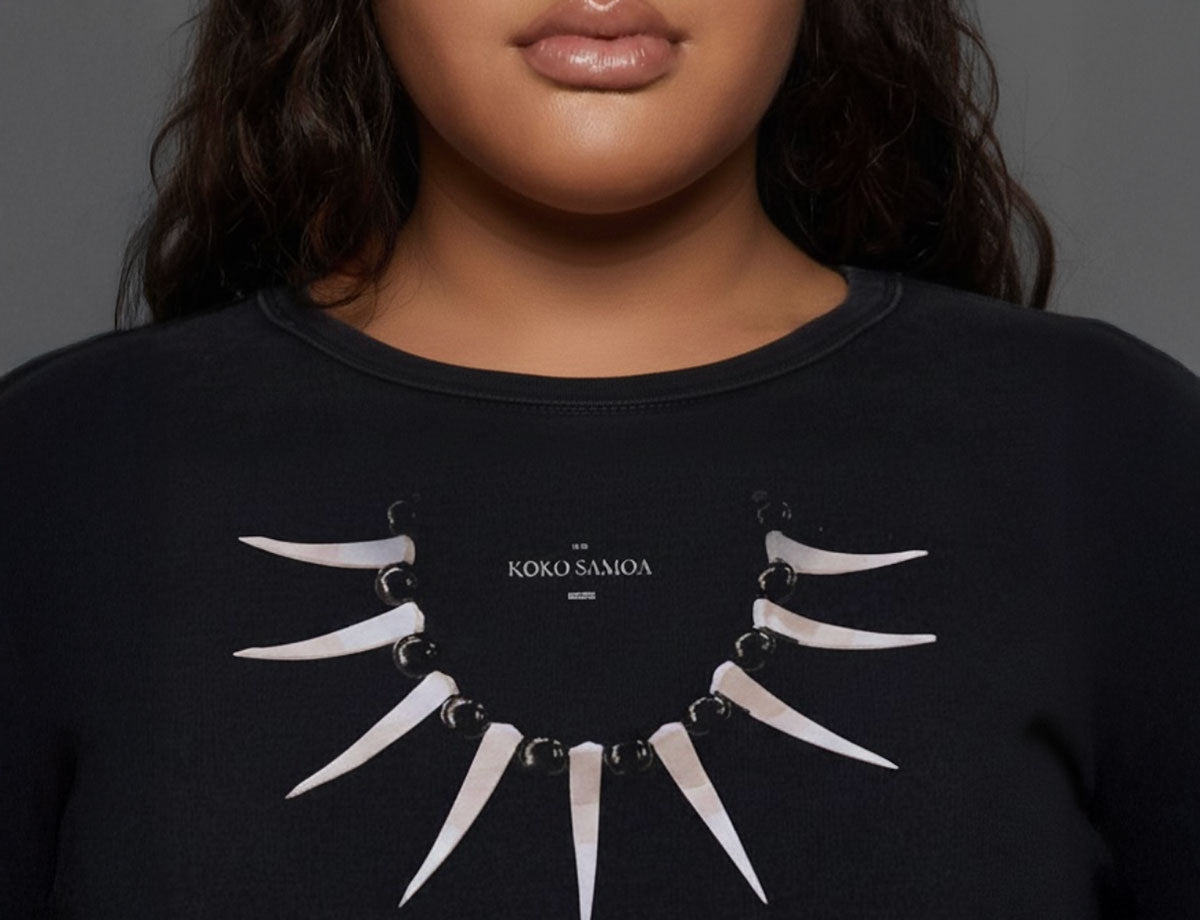
The ula nifo, the necklace of high status, drawn onto a heavy everyday tee. Samoan-designed, made with awareness of the tradition it draws from.
The cultural significance of wearing Samoan design today
For diaspora Samoans, wearing clothing that carries Samoan visual culture is an act of identity affirmation. It says: I know where I come from. I carry this with me. I am proud of it.
This matters particularly for second and third-generation diaspora members who may be more distant from the islands but no less Samoan. Wearing cultural design is one way to maintain a visible connection when language fluency, geographic proximity, and ceremonial participation are limited by the realities of diaspora life.
The ula fala around your neck at graduation and the tatau-inspired pattern on your tee are doing the same work: making visible something that might otherwise be invisible. The malu-inspired design you carry every day does the same, while always keeping faith with the truth that the malu itself is earned, not bought.

The ula fala on a heavy everyday tee, the strand of celebration worn the way you carry it through ordinary days. A daily connection to the heritage.
To understand the marks behind the designs, read our guide to the sacred meaning of the Samoan tatau and the wider visual language of the tatau and siapo. Browse everything in our apparel collection.
Wear the ula, carry the meaning
From the ula fala to the ula nifo, Samoan-designed pieces made with knowledge of the tradition. Never instead of the sacred mark, always in honour of it.
Shop the Ula Fala collection →Made-to-order by a Samoan-owned brand. Worldwide shipping.
Frequently asked questions
What is a traditional Samoan necklace called?
The general Samoan word for necklace or garland is ula. The most culturally significant is the ula fala, made from the seeds of the pandanus plant. Ula fala are worn for celebrations, graduations, and welcoming ceremonies, and are a widely recognised symbol of Samoan identity in the diaspora.
What is the difference between the pe'a and the malu?
The pe'a is the traditional male Samoan tattoo, covering the body from waist to knees in dense geometric patterns. The malu is the female tattoo, covering the thighs from upper leg to below the knee, with a distinctive diamond motif behind the knee. Both are applied by a specialist tufuga ta tatau using traditional hand-tapping methods.
Is the Samoan tatau still practised today?
Yes. The Samoan tatau is a living tradition. Tufuga ta tatau still practise in Samoa and in diaspora communities. It is widely regarded as one of the world's oldest continuous tattooing practices. Note that the tatau itself is not on the UNESCO heritage list; the Samoan element UNESCO inscribed on its Representative List of the Intangible Cultural Heritage of Humanity, in 2019, is the 'ie Samoa (fine mat).
What do tatau patterns mean?
Tatau patterns use a vocabulary of geometric forms: triangles, diamonds, centipede motifs, flying fox shapes, and ocean references. Different motifs and their placement carry meanings relating to identity, lineage, social roles, and the wearer's relationship to family and village. The patterns are not standardised; they are customised by the tufuga for each wearer.
How is traditional Samoan design used in modern fashion?
Samoan-owned and Polynesian designers increasingly use the visual language of the tatau, siapo bark cloth patterns, and traditional geometric motifs in contemporary clothing, accessories, and streetwear. When Samoan designers use Samoan patterns, they continue and adapt the tradition for diaspora communities who want to carry cultural identity in everyday dress.
Is wearing a tatau-inspired design the same as receiving the tatau?
No. The pe'a and malu are sacred marks earned through ceremony, pain, and commitment under a tufuga ta tatau. A printed design carries the visual heritage and lets diaspora Samoans keep a daily connection to it, but it holds none of the spiritual weight, the rite of passage, or the social standing of the tatau itself.


