Short answer: Samoa and Tonga are neighbouring West Polynesian nations with deep shared ancestry stretching back to the Lapita people. Despite common roots, they developed distinct identities. Samoa is governed by the Fa'amatai chiefly consensus system, while Tonga is the Pacific's last Polynesian monarchy. Their languages are related but not mutually intelligible. Both cultures are fiercely proud, rich in oral tradition, and central to the story of the Pacific.
To a casual observer, Samoans and Tongans can look strikingly similar: shared foods, related languages, parallel ceremonies. But centuries of distinct political evolution and separate traditions created two powerfully unique identities. Here is what they share, and where they differ.
In this guide
- What do Samoa and Tonga have in common?
- How do the political systems differ?
- Samoa vs Tonga at a glance
- What are the language differences?
- How do the tatau traditions differ?
- Fa'a Samoa vs anga faka-Tonga
- Samoa and Tonga in the diaspora
- Frequently asked questions
What do Samoa and Tonga have in common?
Samoa and Tonga share a common ancestor: the Lapita people, the ancient seafarers who settled Western Polynesia more than 3,000 years ago. Archaeology places both archipelagos, along with Fiji, as the earliest cultural centres where the distinct Polynesian identity, language, and customs formed before the great expansion eastward and northward.
For centuries before European contact, the oceans between Samoa, Tonga, and Fiji were highways, not barriers. The islands maintained a powerful network of exchange:
- Intermarriage: Royal and chiefly lines frequently intermarried to form alliances. Samoan and Tongan genealogies are deeply intertwined at the highest levels of both societies.
- Trade: Fine mats (ie toga), kava, timber, and craft goods moved between islands as both commodity and ceremonial gift.
- Alliance and conflict: Tongan polities exercised significant influence over parts of Samoa for periods during the first millennium CE, and Samoan resistance to that influence shaped both cultures' concepts of sovereignty and pride.
So the two cultures share many surface features: similar staple foods (taro, breadfruit, coconut, pork), comparable ceremonial structures, related languages, and overlapping values around family, respect, and service. But the differences run deep.
How do the political systems differ?
The most fundamental difference is governance, both nationally and within communities.
Samoa operates on the Fa'amatai system, a form of chiefly consensus governance where families are led by Matai (titled chiefs) who represent them in village councils (fono). Authority is distributed across family networks. Only Matai can stand for parliament, making every Samoan Member of Parliament simultaneously a chief accountable to family and village. The system is horizontal, earned, and communal.
Tonga is the only remaining Polynesian monarchy in the Pacific. It operates a hierarchical system with the King at the apex, descending through a noble class to commoners. Tongan society observes strict protocols of rank, and the concept of anga faka-Tonga (the Tongan Way) is shaped by this hierarchy in a way that Fa'a Samoa is not. Authority in Tonga flows downward from the crown. In Samoa, it is distributed across the aiga networks.
Neither system is superior. Both reflect the genius of their respective cultures. But they produce very different social dynamics.
Samoa vs Tonga at a glance
| Samoa | Tonga | |
|---|---|---|
| Governance | Fa'amatai chiefly consensus | Polynesian monarchy |
| Authority flow | Distributed across aiga networks | Downward from the crown |
| Language | Gagana Samoa | Lea Faka-Tonga |
| Tatau tradition | Unbroken for over 2,000 years | Suppressed in 19th century, now reviving |
| Core values name | Fa'a Samoa | Anga faka-Tonga |
| Shared ancestry | Lapita people, settled the region over 3,000 years ago | |
What are the language differences?
Both Gagana Samoa and Lea Faka-Tonga belong to the same Polynesian language family and share a common ancestor. A linguist hears the relationship immediately. But they are not mutually intelligible. A Samoan speaker and a Tongan speaker cannot have a natural conversation without a shared third language.
Some words carry across. The word for family (aiga in Samoan, ainga in Tongan) and greeting structures show the common root. But consonant shifts, vocabulary divergence, and distinct phonological patterns over centuries of separation mean these are genuinely separate languages. Both have an oral literary tradition of great richness: Samoan lauga (formal oratory) and Tongan formal speech are among the most sophisticated verbal art forms in the Pacific.
How do the tatau traditions differ?
Both cultures have ancient tatau traditions, but the designs, meanings, and ceremonial contexts differ significantly. This is sacred ground, so it deserves care, not slogans.
Samoan tatau is among the most recognised in the Pacific. The pe'a (men's tatau from waist to knees) and the malu (women's tatau on the thighs) are sacred rites of passage. The pe'a in particular is understood as a covenant with Fa'a Samoa, a lifelong commitment to service, family, and cultural responsibility.
Tongan tatau, while historically significant, was largely suppressed during the early Christian missionary period in the 19th century. Contemporary Tongan tattooing draws on a revival of historical patterns, but the tradition is less continuous than its Samoan counterpart. Samoan tatau, by contrast, has never been interrupted. The same hand-tapping tools, geometric vocabulary, and ceremonial structure have continued unbroken for over 2,000 years.
The tatau itself is earned and lived, never bought. What you can carry is a design that honours that visual language, made by a Samoan-owned brand rather than lifted without context.

For the Samoan side of the family. A heavyweight tee that says where you stand in the friendly rivalry.
Fa'a Samoa vs anga faka-Tonga
Both cultures organise life around a named set of core values, but the content and emphasis differ.
Fa'a Samoa (the Samoan Way) centres on tautua (service as the foundation of identity), fa'aaloalo (respect, particularly for elders and Matai), alofa (love and generosity as active practice), and aiga (the primacy of extended family over the individual).
Anga faka-Tonga (the Tongan Way) shares many of these values but is more explicitly shaped by hierarchy and rank. Tongan faka'apa'apa (respect) is understood partly in terms of deference to social superiors, reflecting the monarchical structure. The Tongan concept of loto to (humility of heart) is a similarly core value, emphasising humility and deference as spiritual virtues.
Both ways of life are sophisticated and built to endure. The rivalry between them is not conflict but the creative tension of two great cultures defining themselves alongside each other.
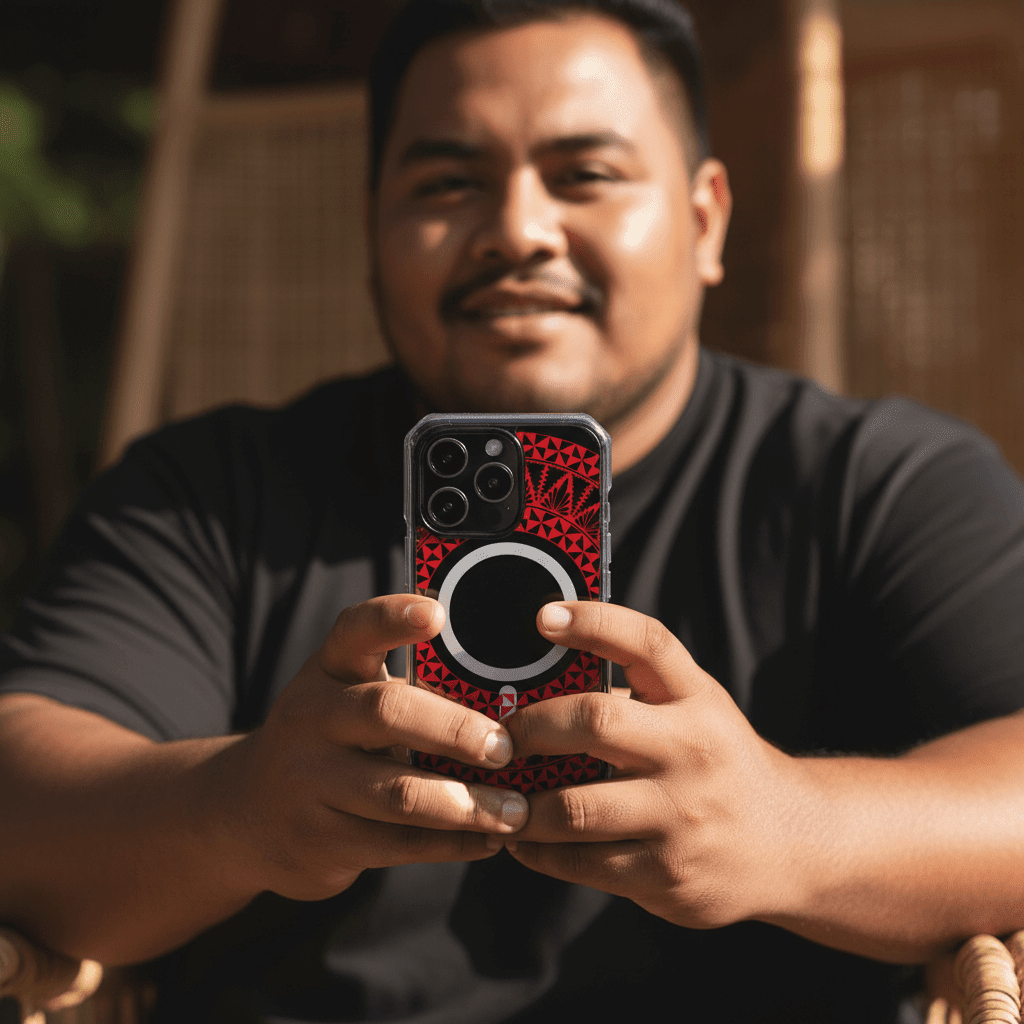
Many diaspora families carry both branches. If yours does, the Tongan MagSafe clear case is a tasteful pick for the Tongan side, the same way the Samoan designs honour ours.

For the Tongan branch of an intertwined family. Clear MagSafe case carrying Tongan design with the same respect.
Samoa and Tonga in the diaspora
Both communities have established significant presences in New Zealand, Australia, and the United States. In many diaspora cities, Samoan and Tongan communities live side by side, worship at the same churches, compete in the same sports, and intermarry. The cultural rivalry sharpens in the diaspora, partly because sport, especially rugby, becomes a major arena of Pacific identity.
For a deeper comparison of the two cultures, see our companion guide Samoan versus Tongan: exploring the heart of Polynesia. To carry the Samoan side of that story, browse the full Samoan apparel collection.
Frequently asked questions
What is the difference between Samoan and Tongan culture?
The most fundamental difference is governance: Samoa operates on the Fa'amatai chiefly consensus system where Matai (titled chiefs) lead family networks, while Tonga is the Pacific's last Polynesian monarchy with a hereditary king and noble class. Both share Lapita ancestry, related languages, and similar family values, but their political structures, tatau traditions, and cultural protocols have developed distinctly over centuries.
Are Samoan and Tongan the same?
No. Samoan and Tongan are distinct languages, cultures, and sovereign nations. They share a common Polynesian ancestry through the Lapita people and a history of intermarriage and trade, but their languages are related yet not mutually intelligible, their governance systems differ fundamentally, and their cultural identities are separately and fiercely maintained.
Which came first, Samoa or Tonga?
Both were settled by the Lapita people as part of the same broad wave of Polynesian settlement roughly 3,000 years ago. Archaeology suggests these two archipelagos, with Fiji, were among the earliest permanently settled islands in the Polynesian world. Neither predates the other in a meaningful sense; they developed contemporaneously from the same ancestral stock.
Do Samoans and Tongans get along?
Generally yes. Samoan and Tongan communities in the diaspora often share churches, schools, sports competitions, and family connections through intermarriage. There is a cultural rivalry, particularly in rugby, but it is the competitive pride of two closely related cultures rather than genuine hostility. Many families across the Pacific have both Samoan and Tongan branches.
What language do Samoans and Tongans speak?
Samoans speak Gagana Samoa and Tongans speak Lea Faka-Tonga. Both belong to the Polynesian branch of the Austronesian language family and share a common ancestor, but they are separate languages and not mutually intelligible. Both have rich oral literary traditions and are taught in community language programmes across New Zealand, Australia, and the United States.
Rep your side with pride
Tatau-led tees, hoodies, and phone cases honouring Samoan heritage, plus a tasteful pick for the Tongan side.
Shop the collection →Made-to-order by a Samoan-owned brand. Worldwide shipping.


