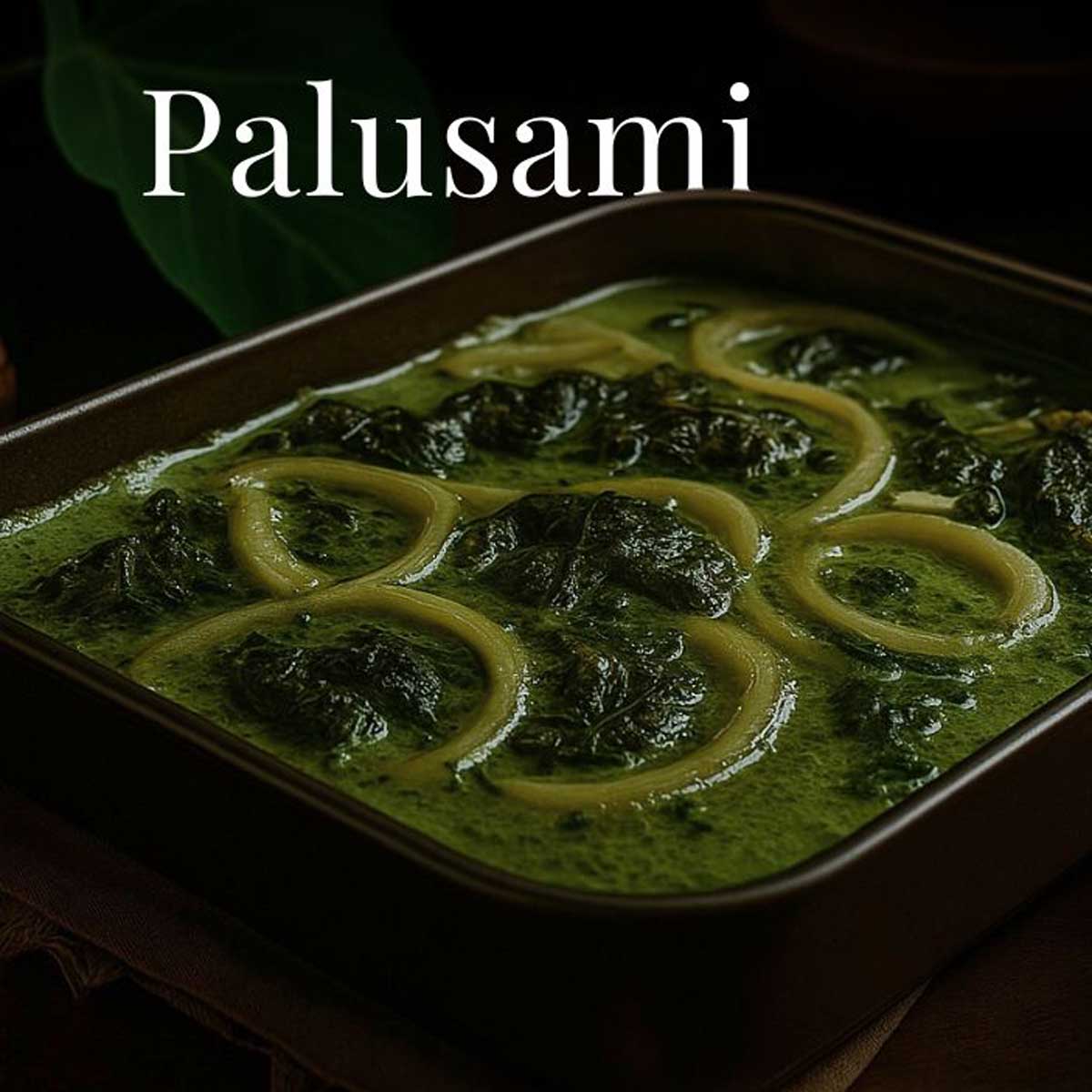
Palusami is taro leaves (luau) packed with thick coconut cream, wrapped tight, and slow-cooked until the filling goes silky. That is the whole dish. Three or four leaves, a pour of coconut cream, some salt, maybe onion or corned beef, then heat does the rest. It works in an umu (earth oven), in your home oven, or in a steamer.
The name gives you a clue: palu means to mix, and sami carries the idea of saltiness. Mix the salty-rich filling. Wrap it. Cook it. Done.
In this guide
- What is palusami?
- A brief history
- What you need
- How to make palusami step by step
- Regional variations worth knowing
- What to serve with palusami
- Make-ahead and storage tips
- Frequently asked questions
What is palusami?
Palusami is a Samoan staple that turns two humble ingredients, taro leaves and coconut cream, into something that belongs at a feast. Stack three or four taro leaves (luau), add the filling, fold the parcel closed, cook low and slow. The leaves soften into the cream. The result is rich, earthy, and a little sweet from the coconut.
One thing to sort out early: in Samoa, luau means the taro leaves. The finished dish is palusami. In Hawaii, luau refers to both the leaves and the feast event. When a Samoan recipe calls for luau, it means the leaves.
A brief history
Taro has been growing in Samoa longer than written records exist. Young leaves (saka) are prized because they are more tender and need less cooking than older leaves. That preference has a practical reason: older leaves contain oxalate crystals that cause throat itch if not cooked long enough.
Missionary journals at the Malua archives mention “leaf pots of creamy coco” being served to Queen Salamasina in the 1800s. The dish already carried ceremony then. At a fa’alavelave, gifting a platter of palusami signals respect at the same level as presenting a fine mat.
During cyclone seasons, when fresh protein was scarce, families added tinned corned beef to the filling. That version, sometimes called Pisupo Palusami, became its own tradition. The canned meat plus coconut cream combination is now deliberate nostalgia for many diaspora families, not a compromise.

Six traditional Samoan mains in a keepsake hardcover. Palusami, chop suey, and more, with full technique notes and cultural context.
What you need
| Ingredient | Notes | Substitute |
|---|---|---|
| Fresh young taro leaves (luau) | Young leaves are more tender and cook faster. Look for deep green, intact leaves without yellowing. | Baby spinach or collard greens. Flavour and texture will differ noticeably. |
| Thick coconut cream | Full-fat, not coconut milk. The richness is the point. Canned works fine. | No good substitute. Lite versions produce a watery result. |
| Salt | Season the cream mixture well before filling. | Soy sauce for a different savour profile. |
| Onion (optional) | Finely diced. Adds mild sweetness as it cooks into the cream. | Spring onion or shallots. |
| Protein (optional) | Tinned corned beef, tinned tuna, fresh fish, or chicken. Mix into the coconut cream. | Leave it out for a vegetarian version that is equally traditional. |
| Banana leaves or foil | For the outer wrap. Banana leaves add fragrance. Foil is reliable and easy. | Foil is the standard home kitchen option. |
How to make palusami step by step
Prep the leaves: Rinse taro leaves well and pat dry. If using older leaves, blanch in boiling water for two minutes and drain. This softens the leaves and reduces throat itch from oxalate crystals. Remove the central stem if it is thick.
Make the filling: Combine thick coconut cream with salt, finely diced onion, and any protein you are using. Season more than you think you need. The leaves absorb a lot of salt during cooking.
Stack and fill: Lay three to four taro leaves overlapping in a shallow cup shape. Spoon a generous amount of coconut cream filling into the centre. Do not overfill or the parcel will split when wrapped.
Wrap and cook: Fold the leaves up around the filling. Wrap in banana leaf or foil, sealing the edges. Place in a baking dish and bake at 180 degrees Celsius for 45 to 60 minutes, until leaves are very soft all the way through and the coconut cream has set into a thick, creamy consistency.
Rest before serving: Let parcels sit for five minutes after removing from the oven. The filling continues to thicken slightly as it cools.
Regional variations worth knowing
In Savai’i, some cooks add fresh chilli to the coconut cream. The heat cuts through the richness. Manono families finish their palusami with a squeeze of native lime just before serving. The acid wakes up the whole dish.
The Pisupo Palusami version (tinned corned beef in the filling) is as common at family gatherings as the plain coconut cream version. It is not a lesser version. Make it the way your family makes it, or try all of them.
What to serve with palusami
Palusami is rich. Everything next to it should give your mouth a break. Boiled taro and green banana are the most traditional pairing. Steamed rice also works and is probably what most diaspora households actually use. Palusami as a side dish next to grilled meats needs nothing else on the plate.
A less obvious pairing: a cup of koko Samoa at the end of the meal. The bitter, roasted cacao cuts through the coconut fat and resets the palate. An old combination that does not get mentioned enough.
For more ideas on building a full Samoan table, see our Oka guide and our Sapa Sui recipe. Both pair well with palusami at a spread.

24 traditional Samoan recipes in one A4 hardcover. Both volumes combined, with palusami, oka, sapa sui, and more, written for the diaspora kitchen.
Make-ahead and storage tips
Assemble the parcels, wrap them, and refrigerate for up to 24 hours before cooking. Pull them out 20 minutes before they go in the oven. Cooked palusami keeps in the fridge for two to three days. Reheat covered in the oven at 160 degrees Celsius for 15 minutes. Do not reheat at high heat or the coconut cream will split.
Frequently asked questions
Why do taro leaves cause throat itch, and how do I stop it?
Taro leaves contain oxalate crystals that irritate the throat if the leaves are not fully cooked. The fix is straightforward: cook them long enough. Blanching before filling helps. Using young leaves reduces the risk because younger leaves have fewer crystals. If you use older leaves, blanch for two to three minutes and drain well.
Can I make palusami without fresh taro leaves?
Yes. Baby spinach or collard greens are the most practical substitutes when taro leaves are hard to find. The flavour and texture will differ. Taro leaves have an earthy, slightly mineral quality that spinach does not replicate. But the method is the same and the result is still good.
What is the difference between palusami and luau?
In Samoa, luau refers to the raw taro leaves. Palusami is the cooked dish made from those leaves with coconut cream filling. The confusion comes from Hawaii, where luau refers to both the taro leaf dish and the feast event. When you see a Samoan recipe calling for luau, it means the leaves.
Can I cook palusami without an umu?
Yes, and most home cooks do. The oven method at 180 degrees Celsius for 45 to 60 minutes works well. A steamer also works. The umu adds a mild smokiness that the oven cannot replicate, but the dish is still palusami without it.
What coconut cream should I use?
Full-fat canned coconut cream. Not coconut milk. Not lite versions. Any full-fat brand works. Shake the can before opening.
Is palusami vegetarian?
The base recipe (taro leaves, coconut cream, salt, onion) is vegetarian. Protein additions are optional. Leave them out and you have a dish that is both traditional and plant-based.
More Samoan recipes, in print
Browse our full collection of Samoan cookbooks, from a slim six-recipe mains keepsake to the combined 24-recipe hardcover.
Browse the cookbooks →Made-to-order by a Samoan-owned brand. Worldwide shipping.


