

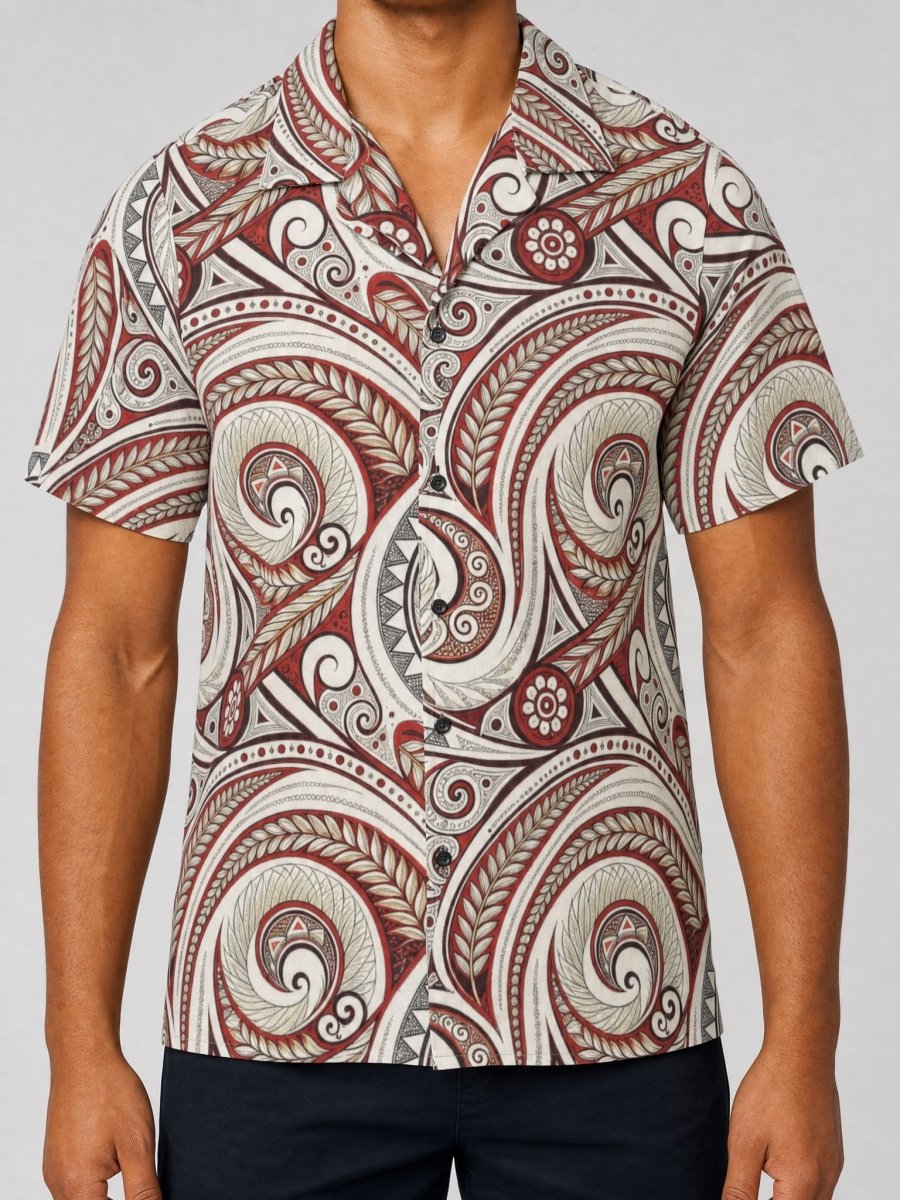
The aloha shirt was invented in Honolulu in the 1930s, not in a factory and not for tourists. Local tailors, many of them Japanese and Chinese immigrants, began cutting loose short sleeved shirts from Japanese kimono cloth for a mixed local market. The name first appeared in print in a Musa-Shiya advertisement in the Honolulu Advertiser on 28 June 1935, and Ellery Chun trademarked Aloha Shirt in 1937. Everything the shirt is now follows from that: a genuinely multicultural Hawaiian garment made for the heat.
In this article
- Who made the first one
- How it left Hawaii
- Aloha Friday
- Why the Pacific wears it
- Reading a real one
- Frequently asked questions
Who invented the aloha shirt?
There is no single inventor, which is the honest answer and a more interesting one. The shirt emerged from several Honolulu tailors at once in the early 1930s, working with what was in the shop.
| Source | What it contributed |
|---|---|
| Japanese kimono fabric | The bright printed cloth, and the habit of bold pattern on a plain shape |
| Filipino barong tagalog | The untucked, straight hemmed silhouette |
| Chinese silk merchants | The material supply and the tailoring trade in Honolulu |
| Hawaiian and local demand | A shirt for working and living in real heat |
The two names that stuck are Musa-Shiya, whose advertisement of 28 June 1935 carries the first known printed use of the phrase, and Ellery Chun of King-Smith Clothiers, who registered Aloha sportswear in 1936 and Aloha Shirt in 1937, and held the rights for the next twenty years.
Chun is often called the inventor. Historians dispute that and describe it as a story that hardened through repetition. What he plausibly did first was keep ready to wear stock on a shelf, which is a real contribution and a less romantic one than inventing the garment.
How did the shirt leave Hawaii?
Servicemen and air travel. Personnel passing through Hawaii during and after the Second World War took shirts home, and the jet age turned a local garment into the thing you brought back from a holiday. By the 1950s it was a mainland fashion item, and the mainland promptly did what it does to borrowed things: turned some of it into a joke.
That split still exists on any rack today. On one side, the shirt as Hawaii makes it: a real garment with a print somebody designed. On the other, the novelty version covered in cocktail glasses, sold for one night.
What is Aloha Friday and why does it matter?
In 1965 the Hawaiian Fashion Guild, led by its president Bill Foster Sr, lobbied for local men to wear aloha shirts to the office on Fridays. It became official policy the following year, in 1966. It worked, it stuck, and it is the direct ancestor of casual Friday as the rest of the world practices it.
That is the part worth holding onto. The aloha shirt is not beachwear that escaped. It is business wear in the place it comes from, worn to work by men who live there, and it was deliberately kept local rather than given away. A shirt with that history earns being worn somewhere ordinary.

The Hawaiian silhouette with Samoan prints on it, named for Samoan places. Camp collar, relaxed cut, printed collar to cuffs.
See the shirts →Why does the rest of the Pacific wear it too?
Because the problem it solves is the same across the region: heat, humidity, and a need for something you can wear to church, to work and to a family gathering without changing. Samoa, Fiji, Tonga and the Cook Islands all have their own printed shirt traditions that sit alongside it, and the camp collar shape travels between them easily.
What changes is the artwork. A Samoan shirt carries elei. A Fijian one carries masi geometry. Calling all of them Hawaiian flattens four distinct traditions into one, which is the most common thing sellers with no connection to the Pacific do. The shape is shared. The print is not.

How do you tell a real aloha shirt from a novelty one?
Four signals, and they are all visible on the hanger.
| Signal | A real one | A novelty one |
|---|---|---|
| Collar | One piece camp collar with no stand | A pointed dress collar, or a stiff interfaced one |
| A designed repeat that runs across the seams | Clip art motifs scattered on a background | |
| Subject | Place, plant, pattern, something from somewhere | Cocktail glasses, flamingos, a joke |
| Hem | Straight and boxy, cut to hang out | Curved shirt tail, made to be tucked |
The print subject is the fastest read. A shirt designed in the Pacific tends to carry a place: a plant that grows there, a pattern from a cloth tradition, a colourway named for somewhere real. A shirt designed to be funny carries a punchline, and a punchline stops being funny on the second wearing.
The other thing worth knowing is that collectors take the vintage ones seriously. Silk and rayon shirts from the 1930s to the 1950s, the era people call the golden age, trade for real money, which is not something that happens to a garment nobody respected.
Every shirt here is printed and sewn after the order is placed, so allow about three weeks from order to door for Australia and New Zealand and closer to four across an ocean. Work back from the date you need it, not forward from today. There is more on the model in why made to order is the future of sustainable fashion.
How to choose a Hawaiian shirt is the practical companion to this: collar, cut, fabric and print, and how to wear one without it reading as fancy dress.
Frequently asked questions
When was the aloha shirt invented?
In the early 1930s in Honolulu. The phrase first appeared in print in a Musa-Shiya advertisement in the Honolulu Advertiser on 28 June 1935, and Ellery Chun trademarked Aloha Shirt in 1937.
Who invented the Hawaiian shirt?
No single person. It emerged from several Honolulu tailors working with Japanese kimono cloth and a Filipino habit of wearing a shirt untucked. Ellery Chun is often credited, but historians treat that as a story that hardened through repetition rather than an established fact.
What is Aloha Friday?
The Hawaiian Fashion Guild lobbied in 1965 for men to wear aloha shirts to the office on Fridays, and it became official in 1966. It is the origin of casual Friday worldwide.
Is the aloha shirt Hawaiian or Japanese?
Both are part of it. It is a Hawaiian garment created in Honolulu, and the printed fabric tradition it drew on came from Japanese kimono cloth sold locally.
A shirt with a real history
Camp collar, relaxed cut, Pacific prints. Made after you order it.
Shop Hawaiian shirts →Made to order. Allow three weeks.
Read next: Polynesian Fashion Hub · Samoan vs Hawaiian


